by Allison Woods | Jun 21, 2010 | Uncategorized
This video contains the full interview with award-winning American playwright, John Patrick Shanley on the set of “Doubt.” This interview was conducted during the 2010 Christian Scholars’ Conference at Lipscomb University. Click to view the...
by Jackson Sprayberry | Jun 15, 2010 | News Slider
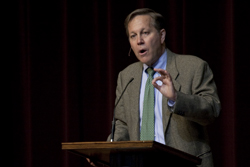
From how the powers and principalities of the world influence the Christians’ role in the play of the world, to finding a story in the world, to how Christians should act in this play put on by the world, attendees of the conference were enlightened on the importance of a relationship between Christianity and the arts. Perhaps one of the most thought-provoking and penetrating insights was delivered by Dana Gioia, a former Chairman of the National Endowment for the Arts. He set out to show the decrease of the Christian’s influence in writing today as compared to the mid-century. “If speaking of [mid-century] literature, you couldn’t do it without mentioning devout Christians,” he said. The names he referenced were those of Flannery O’Conner, Tennessee Williams, Thomas Merton, J.R. Tolken, C.S. Lewis, and Robert Fitzgerald. “All of these individuals identified with Christianity, even though Christianity wasn’t the most prominent idea of their time,” he said. He asserted that while Christians once actively participated, and more importantly influenced, literary review. In the eyes of Gioia, this is no longer true. He sees a group of writers who are Christians but won’t claim their identity in a positive light because they stand to gain nothing. “Society has little to no use for Christianity,” he said. He declared that we as Christians have “ceded the arts to secular culture,” which was a “radical departure from the Christian tradition,” and has left society, “without a transcendent vision.” And because of this departure, Gioia sees a spiritually impoverished society. Gioia adamantly asserted that he wasn’t suggesting all art should have a Christian influence, but rather,...
by Allison Woods | Jun 9, 2010 | News Slider
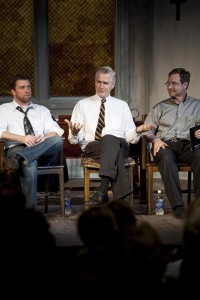
The diversity of the plenary addresses helped the Christian Scholar’s Conference stir conversation and challenge boundaries of perception. John Elkins and John Patrick Shanley both typified their speaking experiences during the weekend gathering at Lipscomb as pleasantly surprising. Neither artist knew much about his potential audience prior to coming here, but they both said the offer to speak at Lipscomb was too intriguing to ignore. A Church of Christ audience is not often presented to these two seasoned speakers. This year’s conference focused on all areas of the fine arts. Elkins opened the entire weekend of scholarship with a look at art and religion. “Two worlds that were once inseparable but have become estranged.” said Laura Lake Smith, chair of the Art Department, describing the reason for the weekend-long examination. Elkins’ invitation was triggered by his book on religious art. He wrote a book blurring the lines on what it means to combine religion and art. His speech was based on his arguments in the book. He talked about the art critics’ immediate dismissal of anything overtly religious. However, Elkins presented criteria for the art world’s acceptance of work that has religious undertones, even claiming that some artists are subconsciously religious. One marquee name — Thomas Kinkade — has been dismissed because he includes an overt statement with his work. Other artists like him similarly are cast aside from serious consideration because of their overtly religious statements. “The difference between conservative and progressive art schools [is based on] their opinion of Kinkade,” Elkins said. Elkins claims that one reason religion and art have been separated is because the topic is not presented in any mediums. Magazines and journals, textbooks, and...
by Jake Morgan | Jun 8, 2010 | Uncategorized
This video contains the final segment of a keynote speech by award-winning American playwright, John Patrick Shanley at the 30th annual Christian Scholars’ Conference. The speech was delivered in Collins Alumni Auditorium at Lipscomb University. Click to view the...
by Chris Shappley | Jun 7, 2010 | Opinion
Lipscomb had a unique opportunity last week to host the Christian Scholars Conference, during which scholars from all over the country descended upon the campus to hear panel discussions and speeches on theology, art, racism and many other topics. But what may have been the highlight of the conference was not a panel or speech, but a play. John Patrick Shanley’s Doubt has been performed on stages all over the country, and has even been turned into a major motion picture starring such masters as Meryl Streep and Philip Seymour Hoffman. But last week, it was Lipscomb’s Mike Fernandez, chair of the Theater Department, who took the director’s role. Directing such a renowned play is probably trying, but when you add the fact that Shanley himself was in attendance for the opener, it’s obvious that it was a taxing — if rewarding — time for Fernandez. I’m happy to report that Doubt was performed without a hitch. And while the play was well directed and acted, the best part of the evening came after the curtain closed that first night. That’s when the talk-back began. Shanley and the cast and designers, including Fernandez, talked openly to audience about what the experience of putting on Doubt meant to them. The audience was able to ask questions, and most of them were directed towards Shanley. It was great to hear from Shanley how he took experiences from his childhood to help him write the play. In a moment of bluntness, Shanley tried to describe what it was like seeing his play being performed at Lipscomb. He said, in so many words,...
