by McCall Graves | Apr 12, 2010 | News Slider
SWANG (LN)- Author, Lecturer of Public Policy, and creator of the Clinton Administration’s National Performance Review, Elaine Kamarck spoke to students and faculty during the Pizza and Politics Series on April 8, 2010 at Lipscomb University. Kamarck spoke on the topic: Is American Government Broken Beyond Repair: Jobs, Religion, and the Great American Recession. “The United States government has always struggled to be functional,” Kamarck said, after addressing whether our country is actually broken. Kamarck made points about how people had changed America as we know it today. Harry Truman was able to make the Marshall Plan, a plan for the United States to rebuild and create a stronger economic foundation for the countries of Western Europe, even though he was “not in good shape” as a president. Another person Kamarck mentioned was Rachel Carson, who (in the vernacular of the time) was considered an “old maid” from Maine with a low level job.. She did not have much going for her in life. She wrote a book called Silent Spring, which helped jump-start the environmental movement. “Wow, sometimes the power of an idea moves powerful people,” Kamarck said. “The founding fathers would be pleased with these stories. They wanted a country in which things happened in all sorts of different ways.” These improvements happened because an unpopular president enforced changes, or because a lowly woman wrote a book on environmental changes. Kamarck spoke highly of America and seemed to have hope for our country. Having a career in government and politics, Kamarck worked for the White House from 1993 to 1997. She helped to create the Clinton Administration’s...
by Dale Lipscomb | Apr 12, 2010 | News Slider
Relying on his cane and the arm of editor Richard Goode, professor of history, Will Campbell made his way in front of the Beaman Library audience recently for a question-and-answer session for his new book, Writings on Reconciliation and Resistance. The March 9 appearance of Campbell, 86, attracted a range of listeners, from Lipscomb students to older adults. Some of the older attendees turned out to be Campbell’s friends who came to support him. In his younger years, Campbell was a civil rights activist. His beliefs on equality are still a defining factor in his character. Campbell’s biggest struggle today is sharing his ideas with a much younger, technological world. Campbell faces new hurdles in communicating with his audience. “In his later years more people want to hear him,” John Egerton, Campbell’s long time friend and car driver for the day, said. “By the time he was able to (reach a wider audience) he had less vigor.” Although Campbell’s age has produced new communication difficulties, people such as Goode recognize the importance in preserving his ideas. “The publisher contacted me and asked me f I would work on this project,” Goode said. Once on board, Goode began digging through archived works and interviewing Campbell to compile information. “Be as small as you can be, and have a beautiful library and a beautiful lady to run it,” Campbell said about how Christian schools should act. “Be proud of an answer like...
by Clay Smith | Apr 12, 2010 | News Slider
Bob Dylan, Bridgett Bardot, Julie Christie, Richard Price, Damien Hurst. What do all of these people have in common? They were all directly impacted by the life and work of Andy Warhol. The Art department presented its second event in the 2010 Presidential Lectureship series Thursday night in Ezell. Dr. Thomas Crow, the featured speaker, addressed the topic “Understanding Andy Warhol.” Crow is a distinguished art historian who has written six books and has taught at both Princeton University and Yale University. He now teaches modern art history at New York University. Crow was answering two main questions in his lecture: what makes Andy Warhol such an iconic figure, and why is his artwork still considered relevant, even though most of his paintings are nearly 50 years old? He began by addressing the direction of art before Warhol. Artists like Richard Hamilton began to experiment with creating art from arising celebrities and iconic figures. This reassembling of advertising and media allowed for the beginning of a new type of artistic expression, called pop art. Crow quoted Mark Rothko, who said, “The familiar identity of things has to be pulverized in order to destroy the finite associations with which our society increasingly enshrouds every aspect of our environment.” Warhol is an icon himself in art, and each of his paintings has been meticulously scrutinized for any shred of meaning. However, few people have been looking at how his works resemble one another. Crow suggested that the common motifs in Warhol’s paintings might speak as loud as each painting individually. Crow pointed to the different depictions of people, such as the...
by Jesse Baker | Apr 11, 2010 | News Slider
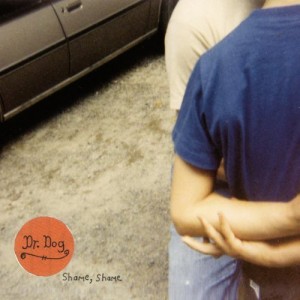
Dr. Dog has long walked the line between indie-rock stardom and virtual obscurity, but if it keeps releasing albums like Shame, Shame, the thought of obscurity will be quickly forgotten. Ripe with driving bass lines and sweeping harmonies, Shame, Shame is yet another home run from the folk-rock sluggers, and it is an impressive follow-up to the critically acclaimed 2008 release Fate, when even the most loyal of fans struggled to see any room for improvement on such a great album. Shame, Shame is far from a letdown off of a successful album; in fact it may be the band’s best work yet. Songs like “Shadow People,” “Jackie Wants a Black Eye” and “I Only Wear Blue” are great examples of how Dr. Dog can stay true to its distinctive sound while still growing and maturing as innovative musicians. Among the familiar sounds of Dr. Dog are the voices of co-lead singers Toby Leaman and Scott McMicken. Although Leaman’s raspy notes and the resonating tenor of McMicken are completely unique, the tones also seem as if they were made for one another. And the bond shows in the ubiquitous Beatles- or Beach Boys-esque harmonies and varied vocal textures exhibited on the album. Also making welcome reappearances are Leaman’s masterful driving bass lines (one of the most outstanding elements of Dr. Dog’s music), the reverberating snare that almost adds the nostalgic rhythm of a steam engine to the songs, and the brilliant guitars, especially on display in “Where’d All The Time Go?” and “Mirror, Mirror.” All these elements come together to make an album that may already be making bids...
by Nick Hogan | Apr 11, 2010 | News Slider
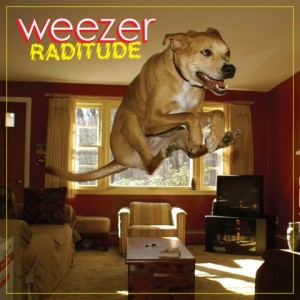
If you don’t enjoy getting songs stuck in your head and singing them all day, you might not want to listen to Weezer’s new album, Raditude. After hearing Weezer’s new single (“If You’re Wondering If I Want You To) I Want You To” via downloadable content for Rock Band on the Xbox 360, I was very excited to hear the rest of the album. When I did, I was not disappointed. Rivers Cuomo, the band’s lead singer and songwriter, has written a good variation of music for this album and has a knack for creating catchy tunes. The only song that Cuomo didn’t write for this album was “In the Mall,” which was written by drummer and backup vocalist Patrick Wilson. “(If You’re Wondering If I Want You To) I Want You To” has extraordinary potential to be a hit, and is just one of those songs that you can’t get out of your head. It also kicks off the album with a bang. The majority of the album has a very Blink-182 feel, but the music is a development from past Weezer albums into a cross between the two bands, and it is extraordinarily successful. The band toured with Blink-182 recently, reflected in songs such as “I’m Your Daddy” and “The Girl Got Hot.” The album also contains a few “love ballads” (and with Weezer, I use that term loosely), which were very typical of Weezer’s musical style. These songs, such as “Put Me Back Together,” “Trippin’ Down The Freeway” and “I Don’t Want To Let You Go,” are typical of any band in this genre, but that...
