by Emily Snell | Jun 28, 2012 | Uncategorized
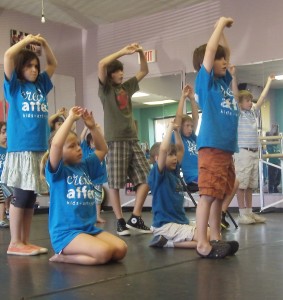
A homeless man sitting on a park bench. A single mom searching for work. Foster kids waiting for new homes. At a small dance studio in East Nashville, young children are rehearsing these scenes from a play, and in the process, nurturing their creative talents and learning about social justice. CreateAffect, a weeklong summer camp for children ages 5-11, educates kids about social justice issues like homelessness and modern-day slavery, while supporting the artistic community and teaching kids to express their creative side. CreateAffect Founder Abby Wahlers said she’s seen the kids come alive as they learn the positive impact they can have on the world. “A lot of kids came alive when they realized that what they were doing was making a difference,” she said. “They see that impact, and they flourish and come alive; and they want to do it more and more. Seeing that makes me come alive and makes me want to do more, and I love it. I love that cycle.” Wahlers, who has degrees in elementary education and human development from Wheelock College in Boston, said she thinks it’s important to teach children about social justice so that they more fully develop their innate empathy. “I think we’re all born with the capability to empathize,” she said. “We’re born with it, but I think along the way, we lose it. But these kids still have it. There are so many areas in their lives where they don’t get to choose, and they don’t get to be a force or to make a difference or to have an impact. When they’re able to reach...
by Emily Snell | Jan 11, 2012 | News Slider
Nearly 2 million children are exploited each year in the global sex industry. Statistics like this are “staggering” says Dr. Randy Spivey, academic director of Lipscomb’s Institute for Law, Justice and Society. Jan. 11 is Human Trafficking Awareness Day, and people across the United States are recognizing those innocent men, women and children who are bought and sold into slavery worldwide. Studies show that 27 million people are enslaved today. Spivey, who taught a course last semester about human trafficking, said the U.S. is one of the greatest consumers of the “product” of modern slavery. Spivey noted that a police officer that took his class used the information he gained during the semester to recognize a human trafficking incident, rescuing a woman who had been held captive for a year and who had been transported across several states. Dr. Cayce Watson, assistant professor of social work, also teaches students about human trafficking so they are prepared if they encounter it in their careers. “Part of social work’s core values is to fight for social justice,” Watson said. “Human trafficking happens everywhere and nowhere. Everywhere because it’s happening and nowhere because people don’t talk about it.” Please upgrade your browser “Some folks have a notion that it happens far away, that it doesn’t happen here,” Watson said. “But we’re kind of a hotbed for that because of our interstates and being close to Atlanta.” According to a 2011 report by the Tennessee Bureau of Investigation, 85% of counties in Tennessee reported at least one case of human trafficking within the past 2 years. “You have to be able to recognize...
